
 Facebook
 X
X LinkedIn
 Forward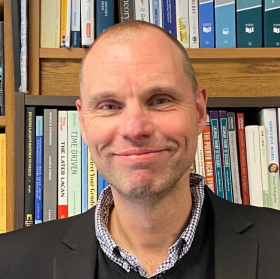
“A Fantasy I Didn’t Know I Had”: Sexual Fantasy as Turning-point in a Psychoanalytic Treatment - Derek Hook, PhD (Webinar live online)
Obsessional neurotic analysands are notoriously good at neutralizing a psychoanalytic treatment. They annul the role of the analyst, avoid the dimension of the Other’s desire (or lack), deny the relevance of parapraxes, and use free association as a means of defense. Given then that the obsessional, for Lacan, is never where they say they are, that their intellectual engagement with a treatment often occurs at the expense of their participation at the level of being, then what is it that makes change possible? This paper responds to this question with a vignette drawn from a lengthy piece of clinical work with an analysand who suffered from a series of urinary symptoms. A turning-point in the work came when the analysand, started speaking, free associatively, about a fictional scene in a novel (a scene of an illicit sexual encounter). This (mis-remembered) scene suddenly jarred a repressed sexual memory, which in turn posed for them a question of desire they did not know they had. Three Freudian and Lacan conceptualizations help illuminate the vignette: Freud’s account of beating fantasies; ‘aphanisis’ (or, the fading of the subject); and the idea of urinary flow as object a.
Target Audience
______ Introductory ______X Intermediate ______ Advanced
Learning Objectives
- After attending this presentation, colleagues will be able to understand and apply concepts pertaining to the resistance that obsessional neurotic subjects typically pose in respect of psychoanalytic treatments
- After attending this presentation, colleagues will be able to identify and discuss the Lacanian notion of fantasy as it pertains to repressed sexual history
- After attending this presentation, colleagues will be able to discuss and illuminate how considerations of bodily drive are related to unconscious desire, with particular reference to activities of urinary flow.
Course summary
- 1.00 AMA PRA Category 1 Credit™

ACCME - As a Jointly Accredited Organization, The Austen Riggs Center, Inc. designates this learning activity for a maximum of 1.00 AMA PRA Category 1 Credit™. Physicians should claim only the credit commensurate with the extent of their participation in the activity.
- 1.00 APA
As a Jointly Accredited Organization, The Austen Riggs Center, Inc. designates this learning activity for 1.00 continuing education credit(s) (CE) for psychology. Continuing Education (CE) credits for psychologists are provided through the co-sponsorship of the American Psychological Association (APA) Office of Continuing Education in Psychology (CEP). The APA CEP Office maintains responsibility for the content of the programs.
Austen Riggs Center, Inc. is recognized by the New York State Education Department’s State Board for Psychology as an approved provider of continuing education for licensed psychologists #PSY-0115.
- 1.00 ASWB-ACE
 As a Jointly Accredited Organization, The Austen Riggs Center, Inc is approved to offer social work continuing education by the Association of Social Work Boards (ASWB) Approved Continuing Education (ACE) program. Organization, not individual courses, are approved under this program. State and provincial regulatory boards have the final authority to determine whether an individual course may be accepted for continuing education credit. Austen Riggs Center maintains responsibility for this. Social workers completing this Webinar live will receive 1.00 continuing education credit(s).
Austen Riggs Center, Inc is recognized by the New York State Education Department's State Board for Social Work as an approved provider of continuing education for licensed social workers #SW-0843.
- 1.00 Contact Hours/ ParticipationA certificate of attendance for all Learners.
Derek Hook, PhD, is a professor in psychology and a clinical supervisor at Duquesne University. A scholar and practitioner of psychoanalysis, he is one of the editors (along with Calum Neill) of the Palgrave Lacan Series and of the four-volume Reading Lacan's Ecrits (with Calum Neill and Stijn Vanheule). He began his analytical training in London, at the Center for Freudian Analysis and Research. He is the author of Six Moments in Lacan (2016), Fanon, Psychoanalysis and Decolonial Psychology (2025) and the co-editor (with Leswin Laubscher and Miraj Desai) of Fanon, Phenomenology and Psychology (2023), in addition to many papers on various facets of the clinical and cultural dimensions of Lacanian Psychoanalysis and Fanon’s psychology. He maintains a YouTube channel with many lectures on Lacanian Psychoanalysis.
Austen Riggs Center Inc. adheres to the ACCME’s Standards for Integrity and Independence in Accredited Continuing Medical Education. All those at Austen Riggs Center involved in the planning of this activity, including the presenter(s) listed above, report they have no relevant financial relationships with an ineligible company*.
The views and opinions expressed in this presentation are those of the presenter(s) and do not necessarily represent the official policy or position of the Austen Riggs Center.
* An ineligible company is any entity whose primary business is producing, marketing, selling, re-selling, or distributing healthcare products used by or on patients.
Available Credit
- 1.00 AMA PRA Category 1 Credit™
ACCME - As a Jointly Accredited Organization, The Austen Riggs Center, Inc. designates this learning activity for a maximum of 1.00 AMA PRA Category 1 Credit™. Physicians should claim only the credit commensurate with the extent of their participation in the activity.
- 1.00 APA
As a Jointly Accredited Organization, The Austen Riggs Center, Inc. designates this learning activity for 1.00 continuing education credit(s) (CE) for psychology. Continuing Education (CE) credits for psychologists are provided through the co-sponsorship of the American Psychological Association (APA) Office of Continuing Education in Psychology (CEP). The APA CEP Office maintains responsibility for the content of the programs.
Austen Riggs Center, Inc. is recognized by the New York State Education Department’s State Board for Psychology as an approved provider of continuing education for licensed psychologists #PSY-0115.
- 1.00 ASWB-ACE As a Jointly Accredited Organization, The Austen Riggs Center, Inc is approved to offer social work continuing education by the Association of Social Work Boards (ASWB) Approved Continuing Education (ACE) program. Organization, not individual courses, are approved under this program. State and provincial regulatory boards have the final authority to determine whether an individual course may be accepted for continuing education credit. Austen Riggs Center maintains responsibility for this. Social workers completing this Webinar live will receive 1.00 continuing education credit(s).
Austen Riggs Center, Inc is recognized by the New York State Education Department's State Board for Social Work as an approved provider of continuing education for licensed social workers #SW-0843.
- 1.00 Contact Hours/ ParticipationA certificate of attendance for all Learners.